


How to Win Tenders: A Practical Guide for Electronics Suppliers

A tender is a formal request in which a buyer asks several suppliers to quote for the same goods under the same conditions. Knowing how to win tenders is therefore less about having the lowest price and more about sending the offer that is easiest to trust and easiest to compare.
This guide is written for wholesalers, distributors, refurbishers and traders who supply mobile phones, laptops, tablets and accessories to business buyers across Europe. It covers how to read a tender, how to price it, what to include in your offer and the mistakes that cost suppliers the deal.
What Is a B2B Electronics Tender?
In wholesale electronics, a tender is usually a short, specific request rather than a long public procurement document. A buyer states the product, the quantity, the condition and the delivery terms, and suppliers reply with an offer.
A typical request includes:
- Product and specification: model, storage, colour and regional version, for example EU or UK specification
- Quantity: a fixed number of units, or a range with a minimum order
- Condition: new and sealed, refurbished, or used with a stated grade
- Delivery: destination country, deadline and who pays for shipping
- Payment: when and how the buyer intends to pay
Because every supplier answers the same request, the buyer can put the offers side by side. That is the main difference from an auction, where the price moves until the sale closes. Our comparison of auctions vs B2B tenders explains both models in more detail.
How to Win Tenders: Seven Steps
The steps below follow the order in which most buyers evaluate an offer. Each one removes a reason for the buyer to choose someone else.
1. Read the request twice before you quote
Most lost tenders are lost at this stage. A quote for the wrong storage size, the wrong regional version or the wrong grade is not compared with the others; it is simply set aside.
Check every field and write down anything that is unclear. If the request allows questions, ask them early. A precise question also shows the buyer that you know the product.
2. Quote only for stock you can deliver
Offer what you hold or can secure with confidence, and say which it is. A buyer who receives part of an order, or the wrong grade, rarely buys from the same supplier again. If you can only supply part of the quantity, offer that part clearly instead of promising the full amount.
3. Price the whole deal, not just the unit
Buyers compare the total cost of an offer. Before you set a unit price, add up:
- Purchase or replacement cost of the stock
- Testing, grading and repackaging, if needed
- Shipping, insurance and any customs costs to the destination country
- VAT treatment for cross-border sales within Europe
- Payment fees and the cost of waiting for payment
A slightly higher unit price with clear delivery terms often beats a lower price that leaves the buyer guessing about extra costs.
4. Make your offer easy to compare
A buyer reviewing five offers will favour the one that answers every point in the same order as the request. Keep the format simple:
- Exact product description, matching the request word for word
- Quantity available and the minimum you will accept
- Unit price and total price, with the currency stated
- Condition and grade, with a short definition of the grade
- Delivery time from payment, and the delivery terms
- Warranty or return conditions
- Payment terms
If something in your offer differs from the request, say so in one sentence rather than hiding it in the details.
5. Prove the stock exists
Trust decides close tenders. Buyers are wary of suppliers who cannot show what they are selling, so give them evidence before they ask: recent photos or a short video of the actual units, an IMEI or serial number list where relevant, and test reports for refurbished stock.
6. Show who you are
A complete company profile matters as much as the price. Include your registered company name, VAT number, address and trading history, and keep these details consistent across your offer, invoice and bank account. Buyers increasingly run their own checks before paying, and a supplier who passes them easily moves to the top of the list.
7. Answer fast and follow up once
Many electronics tenders close within days because prices and availability change quickly. Reply to questions on the same day if you can. If you have not heard back after the deadline, one short, polite follow-up is enough to find out where you stand and what would have won the deal.
Common Mistakes That Lose Tenders
- Quoting before reading the full specification
- Leaving out shipping, VAT or payment terms
- Describing the condition with a grade the buyer cannot interpret
- Sending a different product "as an alternative" without being asked
- Changing the price or quantity after the offer is accepted
- Missing the deadline by a few hours
Each of these tells the buyer that working with you will take extra effort. In a tender, the buyer usually has another offer that does not.
Winning Tenders Across Europe
Selling to buyers in other European countries adds a few points to check. Confirm whether the buyer needs EU or UK specification devices, which charger or plug type is expected, and which language the packaging and manuals should be in. Agree on delivery terms in writing, for example whether the price includes delivery to the buyer's warehouse or only collection from yours.
For sales between EU businesses, the VAT treatment depends on the countries involved and on both companies holding valid VAT numbers. If you are unsure, check with your accountant before you quote, because a VAT mistake can turn a winning price into a loss.
How Tenders Work on Moberca
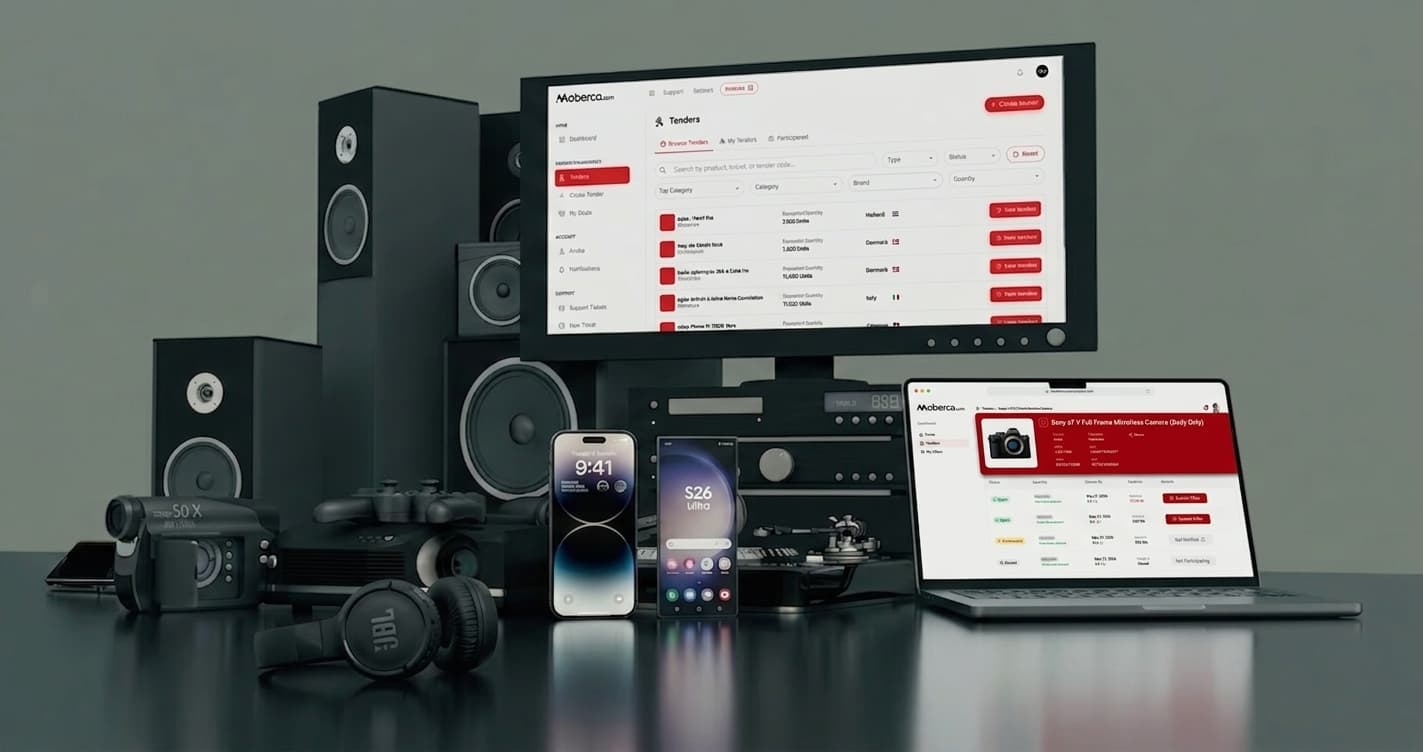
Moberca is a B2B wholesale platform for consumer electronics where verified buyers and suppliers trade through digital tenders. Buyers publish what they need, and suppliers respond with offers that are compared on price, documents and qualifications in one place.
For suppliers, the process is simple:
- Create an account and add your company details. The Basic plan is free and lets you submit offers on open tenders.
- Browse the open tenders and choose the requests that match your stock.
- Submit your offer with price, quantity, condition, delivery terms and supporting documents.
- Answer the buyer's questions and finalise the agreement if your offer is selected.
If you also want to publish your own tenders, for example to buy stock for resale, the Enhanced plan covers both. See our pricing page for the differences between plans, or read how suppliers join tenders on Moberca. If you hold surplus stock rather than waiting for a matching request, our guide to selling excess electronics stock explains the other routes.
Browse the open tenders to see what buyers are asking for today, or create a supplier account to send your first offer.
Frequently Asked Questions
What is the most important factor in winning a tender?
Matching the request exactly. A competitive price only counts if the product, quantity, condition and delivery terms are the ones the buyer asked for.
Do I need the lowest price to win?
No. Buyers compare total cost and risk. A clear offer with proven stock, reliable delivery and fair payment terms often wins over a cheaper but vague one.
What documents should I include with a tender offer?
Company details and VAT number, photos or a video of the stock, an IMEI or serial number list where relevant, test reports for refurbished items and your warranty or return conditions.
Can I submit an offer for part of the quantity?
Often yes, if the request allows it. State clearly how many units you can supply and when, so the buyer can combine your offer with others.
Is it free to submit offers on Moberca?
Yes. The Basic plan is free and lets you respond to open tenders once your company details are entered. Publishing your own tenders requires the Enhanced plan.
Ready to Source Wholesale Electronics?
Join Moberca and start sourcing wholesale electronics through verified B2B tenders. Competitive pricing, transparent process, global reach.
Get StartedRelated Articles

How to Sell Excess Electronics Stock in the UK
If you need to sell excess stock in the UK, timing matters more with electronics than with almost any other category. This guide explains how to prepare the stock, compares six ways to sell it and shows what to check before choosing an excess stock buyer.
Wholesale Electronics: How to Source in Bulk Through Verified B2B Tenders
Learn how the wholesale electronics market works in the UK and Europe, which product categories move the most volume, what to check before paying a supplier, and how a digital tender lets you compare several offers side by side.
What Is Wholesale Electronics Trading? A Beginner’s Guide
Anyone sourcing electronics for the first time in bulk quantities will run into terms like MOQ, trade pricing, and tenders. This guide breaks it all down.